
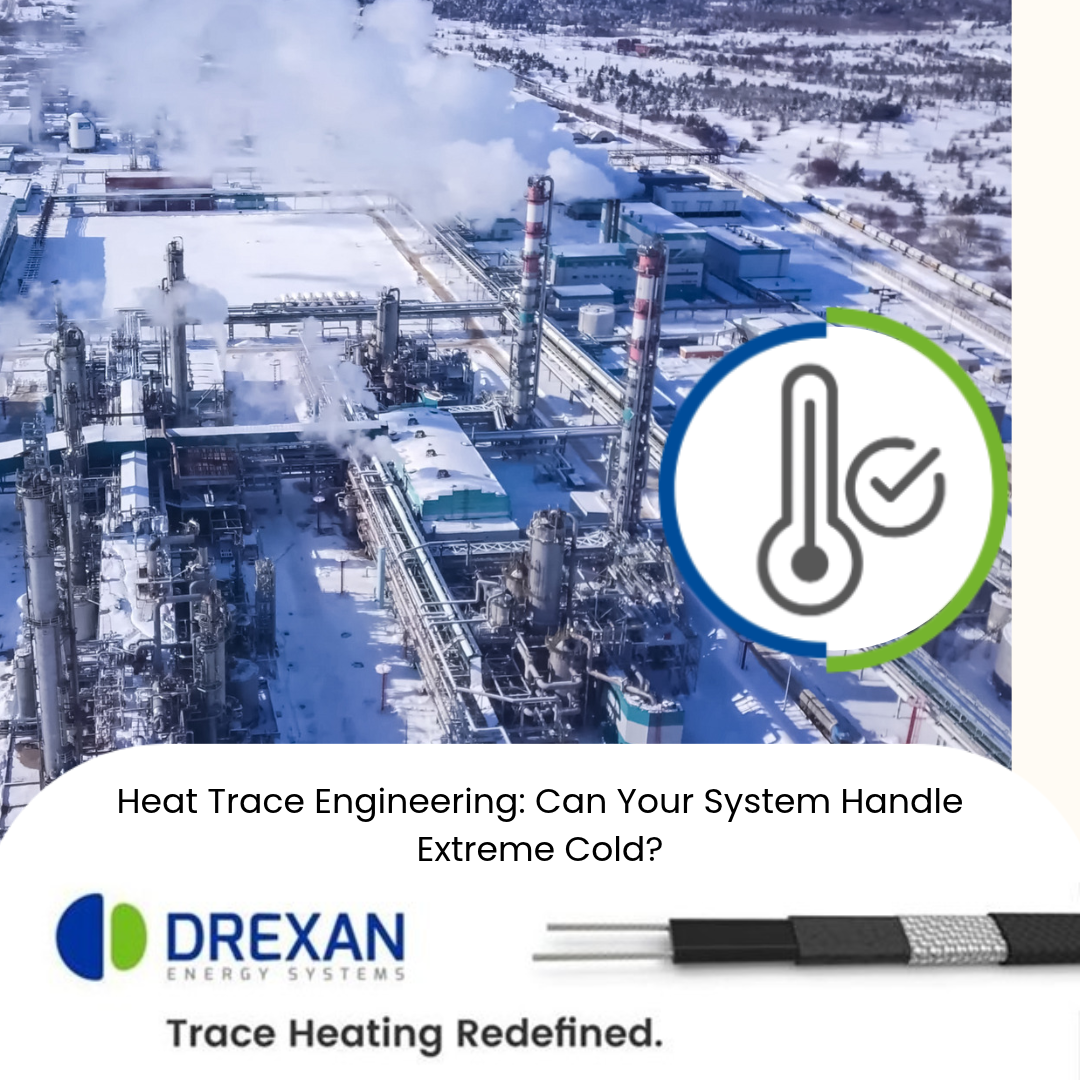
When winter temperatures plunge to -30°C or -40°C, will your heat trace system continue to protect critical infrastructure? For engineers designing freeze protection systems across Canada and the northern United States, extreme cold presents challenges that go beyond selecting the right heating cable.
Sustained low temperatures increase heat loss, place greater demands on electrical systems, and can expose weaknesses in system design. A heat trace system that performs adequately during moderate winter conditions may struggle when temperatures remain well below freezing for extended periods.
What should engineers consider when designing heat trace systems for extreme cold?
- Are You Designing for the Lowest Expected Ambient Temperature?
One of the most important decisions in heat trace design is establishing the minimum ambient temperature. A system designed for -20°C conditions may not deliver sufficient heat when temperatures fall to -40°C.
Engineers need to evaluate the lowest anticipated ambient temperature, the required pipe maintenance temperature, and the duration of exposure. For northern installations, designing around typical winter temperatures rather than realistic worst-case conditions can leave critical infrastructure vulnerable.
- Have You Accounted for Heat Loss and Insulation Performance?
As ambient temperatures decrease, the difference between the pipe maintenance temperature and surrounding air increases, resulting in greater heat loss. Thermal insulation plays a critical role in limiting that loss.
Engineers should evaluate:
- Pipe diameter, material, and required maintenance temperature.
- Insulation type, thickness, and thermal performance.
- Additional heat loss at valves, flanges, supports, and other heat sinks.
- Exposure to moisture, wind, and severe weather conditions.
Increasing insulation thickness can sometimes reduce the heating cable output required, improving system efficiency and potentially reducing electrical demands.
The objective is to ensure that the heat supplied by the cable is sufficient to offset heat loss under the specified design conditions.
- Can Your Electrical System Handle a Cold Start?
Extreme cold creates another important consideration: startup current. Self-regulating heating cables draw more current when they are cold. As the cable warms, its electrical resistance increases and power output decreases.
When a system is energized at very low temperatures, startup current can be significantly higher than during normal operation. Engineers must evaluate whether the available voltage, circuit protection, and electrical infrastructure can accommodate these conditions.
A system designed for continuous operation may have very different electrical requirements when starting from -40°C.
- Are Your Circuit Lengths Appropriate for Extreme Cold?
Long heating circuits can become particularly challenging in northern installations. Maximum allowable circuit lengths depend on several factors, including heating cable type, operating voltage, circuit-breaker capacity, and minimum startup temperature.
As startup temperatures decrease, allowable circuit lengths may need to be reduced to accommodate higher initial current. Engineers should verify manufacturer specifications before finalizing circuit layouts.
In some applications, dividing longer runs into multiple circuits or evaluating alternative voltage configurations may provide a more practical solution.
- Will Your Heating Cable Deliver the Required Output?
Selecting heating cable based solely on its nominal wattage may not be sufficient. Engineers need to verify that the selected cable can deliver the required heat output at the specified maintenance temperature and under actual installation conditions.
Drexan’s self-regulating heating cables are manufactured to a tight -0/+10% power output tolerance, helping engineers design around predictable cable performance.
However, cable output is only one part of the equation. Reliable freeze protection requires the heating cable, insulation, electrical design, and controls to work together.
Engineering for Extreme Cold Requires a Complete System Approach
In northern climates, the consequences of inadequate freeze protection can be significant, from frozen process piping and damaged equipment to costly production interruptions.
The most effective approach is to evaluate extreme cold conditions early in the engineering process rather than compensate for design limitations after installation.
At Drexan, we help engineers evaluate heat loss, heating cable selection, electrical requirements, and circuit design for demanding industrial and commercial applications.
Is your heat trace system engineered for the coldest conditions it may encounter?
Contact Drexan’s technical team at 1-800-663-6873 to discuss your application and ensure your freeze protection system is designed to perform when temperatures reach their lowest point.
Trace Heating Redefined.