
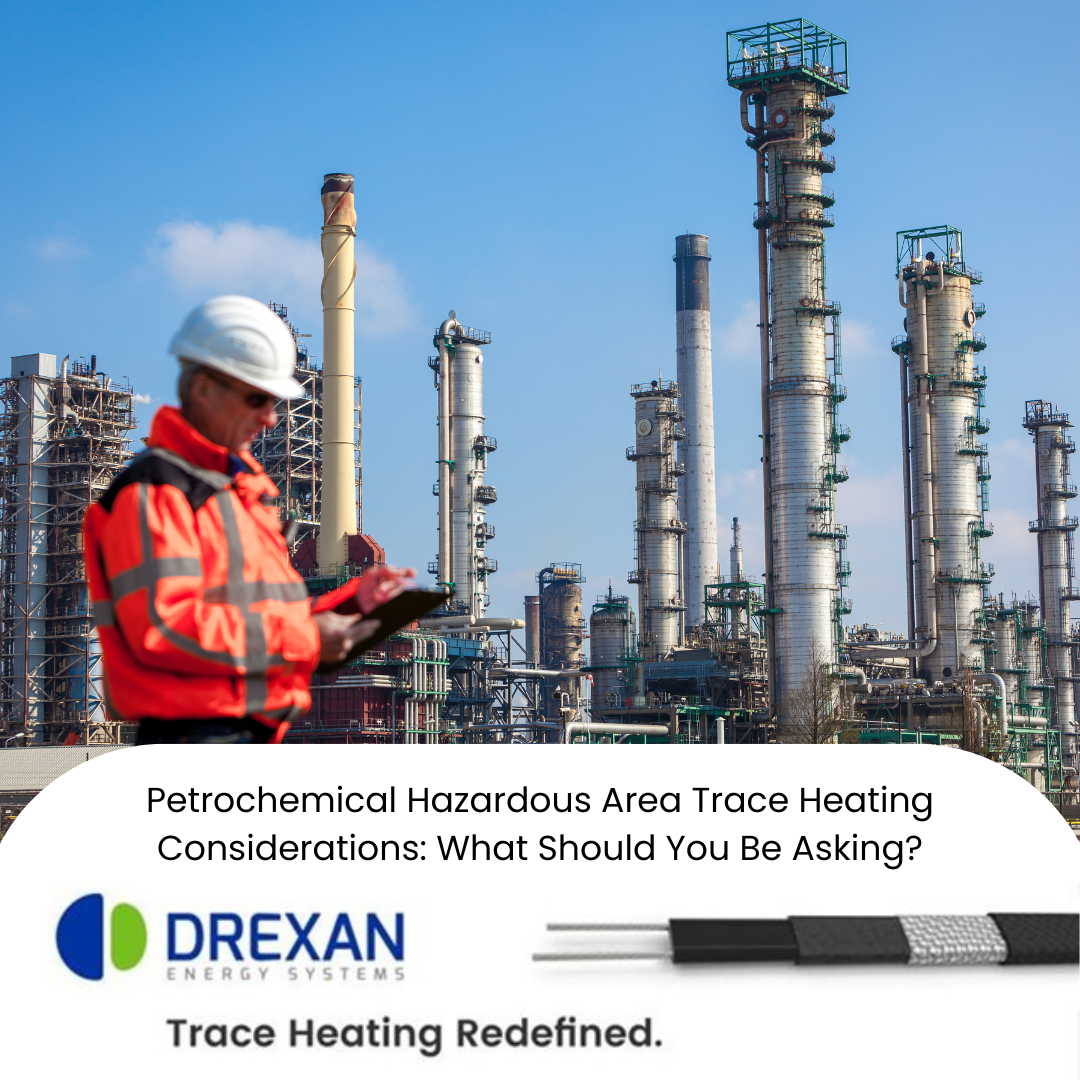
In petrochemical facilities, trace heating often operates in some of the most demanding environments imaginable. Refineries, chemical processing plants, tank farms and other petrochemical operations may contain flammable gases or vapours. Piping within the facility can be exposed to extreme ambient temperatures, corrosive environments and demanding process conditions.
The trace heating system may be responsible for maintaining temperatures critical to product flow, process performance and plant uptime. That makes heat trace selection about much more than determining how many watts per foot are required. For facility managers, engineers and installers, the more important question is:
Has the entire trace heating system been designed for the environment in which it will operate?
Here are some of the considerations that should be addressed before a petrochemical hazardous-area heat trace system is specified, installed or upgraded.
- How is the Area Classified?
This should be one of the first questions asked.
Hazardous locations are classified according to the likelihood that flammable gases, vapours or other combustible materials may be present. Under the Class/Division system used in North America, Class I locations involve flammable gases or vapours.
Division 1 applies where hazardous gases or vapours may be present under normal operating conditions, while Division 2 generally applies where they would only be present under abnormal conditions, such as a leak or equipment failure.
Why does that distinction matter?
Because the classification affects the cables, connection systems, junction boxes, fittings, controls and installation methods that can be used.
A heat trace system should never be designed independently of the hazardous-area classification. Engineers need to know where classified boundaries occur, installers need to understand which components are approved within those boundaries, and facility managers need assurance that subsequent maintenance or modifications haven’t compromised the original system design.
- Is the Cable Rated for the Hazardous Location?
Not every trace heating cable is suitable for every industrial environment. Drexan’s PipeGuard self-regulating heat trace cables are rated for Class I, Division 1 applications, making them suitable for demanding hazardous gas environments when installed in accordance with their certifications and applicable requirements.
But cable certification is only one part of the equation.
A common mistake is to focus heavily on the heating cable while paying less attention to what happens where that cable is powered, spliced, terminated or connected.
In a hazardous location, those details matter.
- Are the Connection Components Properly Rated Too?
Think about the heat trace system as a chain.
The cable may run hundreds of feet along piping, but its reliability and compliance can depend on what happens at a handful of connection points. These points include power connections, tees, splices, end terminations, junction boxes and cable entries. Each needs to be appropriate for its location.
Drexan’s heat shrink family of connection kits is rated for Class I, Division 2 locations. Drexan metallic connection components can also be used in Class I, Division 1 environments when installed with the appropriate DIV1-ADP (DREX0019) Class I, Division 1 Adapter Kit at each cable entry.
Drexan’s AMIGA connection system is CSA/UL (CUS) certified for hazardous locations up to Class I, Division 2.
This is where system design can make a significant difference to both safety and project cost.
- Can Connection Points Be Located Outside the Division 1 Area?
Sometimes the smartest hazardous-area solution isn’t a more complicated component. It’s better system layout.
Where the facility design permits, engineers may be able to locate junction boxes and connection points outside the Division 1 boundary. In many industrial installations, connection points are positioned at least 3 metres (10 feet) outside the Division 1 hazardous area, placing those components within a Division 2 location. By doing this, it
can simplify installation and allow the use of appropriate Division 2-rated connection components while maintaining the required system integrity.
This is why hazardous-area heat trace design should be considered early. A relatively small design decision about the location of a connection point can affect component selection, installation complexity and overall project cost.
Ask yourself, could changing the connection location simplify the installation without compromising performance or safety? It is a question worth asking before the system reaches the field.
- What Temperature Does the Process Actually Need?
Hazardous-area certification doesn’t replace good thermal design. The system still has to perform its primary job.
Is the objective freeze protection? Maintaining product viscosity? Preventing crystallization? Keeping process fluids within a defined operating range?
Engineers need to consider factors including pipe size and material, insulation type and thickness, minimum ambient temperature, required maintain temperature, exposure conditions and expected heat loss.
Selecting more wattage than required isn’t necessarily better. It can increase electrical loads, circuit requirements and operating costs. Selecting too little can leave the system incapable of maintaining the required process temperature. The objective is to deliver the right amount of heat for the application.
Drexan’s self-regulating PipeGuard cables automatically vary their heat output in response to temperature, helping deliver heat where it is required while supporting efficient system operation.
- Have Maximum Temperatures and T-Ratings Been Considered?
In a hazardous environment, temperature is also a safety consideration. Equipment needs to be selected so that its maximum surface temperature is appropriate for the gases or vapours that could be present.
That means designers need to look beyond the desired pipe-maintenance temperature and consider cable output, exposure temperatures, operating conditions and the applicable temperature classification or T-rating.
The question isn’t simply: Will this cable keep my process warm enough?
It is also: Is every component suitable for the temperatures and hazardous environment it may encounter?
Both questions need to be answered.
- Has Ground-Fault Protection Been Properly Designed?
Electrical protection is another critical part of heat trace system design. Drexan installation requirements call for ground-fault equipment protection for heat tracing circuits in accordance with applicable codes and certifications. This is important because conventional circuit breakers may not protect against all electrical arcing conditions resulting from damaged or improperly installed heating cable.
Metallic structures supporting the heating cable, including metal piping, also need to be properly grounded.
These requirements shouldn’t be treated as details to resolve at the end of an installation. Electrical protection, grounding and circuit design should be considered as part of the overall heat trace design from the beginning.
- Is the Installation Method Appropriate for the Hazardous Location?
Even correctly specified equipment can be compromised by an incorrect installation.
Hazardous-location installations require personnel who understand both trace heating systems and the requirements associated with classified areas.
Installers should follow the manufacturer’s design documents and installation instructions as well as applicable electrical codes. Components and cable ends must be kept dry before and during installation, grounding needs to be completed correctly, approved components should not be substituted, and wiring methods need to be appropriate for the hazardous-area classification.
This is particularly important when an installation detail that may be perfectly acceptable in a non-hazardous location is not permitted in a classified environment.
- How Will You Know the System was Installed Correctly?
Inspection and testing shouldn’t begin after a problem occurs.
Insulation resistance or Megger testing provides an important measure of the electrical integrity of the heat trace circuit and can help identify problems including mechanical damage, moisture intrusion and deteriorating insulation.
Drexan recommends regular insulation resistance testing as part of a preventative maintenance program. For Drexan self-regulating heat trace systems, testing with a 500 VDC insulation resistance tester should typically produce a minimum reading of 20 megohms (MΩ), subject to the applicable product instructions and project requirements.
Just as importantly, record the results. Testing during installation, commissioning and subsequent maintenance creates a performance history for the circuit. A gradual decline in insulation resistance can provide an early indication of a developing problem before it results in a failure.
For a petrochemical facility where an unexpected shutdown can have significant operational consequences, that information can be extremely valuable.
- What Happens After the System Is Commissioned?
A petrochemical heat trace system may remain in service for years or decades.
During that time, insulation is removed and replaced. Piping is serviced. Valves are changed. Instruments are added. Contractors work around the cable. Junction boxes are opened. Process requirements change.
The heat trace system that was correctly installed on day one may not necessarily remain that way.
Facility managers should incorporate heat tracing into preventative maintenance programs that include visual inspections, electrical testing, verification of controls and alarms, inspection of connections and review of historical test results.
The goal should be to identify deterioration before it becomes an operational problem.
Hazardous-Area Heat Trace Requires a System Approach
There is no single component that makes a petrochemical trace heating system safe, reliable and compliant.
It comes from understanding how all the pieces work together:
- Hazardous-area classification
- Heating cable selection
- Connection and termination components
- System layout
- Temperature requirements and T-ratings
- Circuit and ground-fault protection
- Proper installation
- Inspection and commissioning
- Preventative maintenance and testing.
That is why the best time to ask questions isn’t after installation begins. It is during design.
At Drexan Energy Systems, we believe technical support is just as important as the cables and connection systems themselves. Our team works with engineers, contractors, installers and facility teams to help ensure trace heating systems are properly designed for the environments in which they need to perform.
From hazardous-area applications and process temperature maintenance to freeze protection, our technical team can help you evaluate the complete system, not just the cable.
Do you have questions about a petrochemical hazardous-area heat trace application?
Talk to Drexan’s technical team before you specify or install your next system. Call our North American TechLine at 1-800-663-6873.
Trace Heating Redefined.