
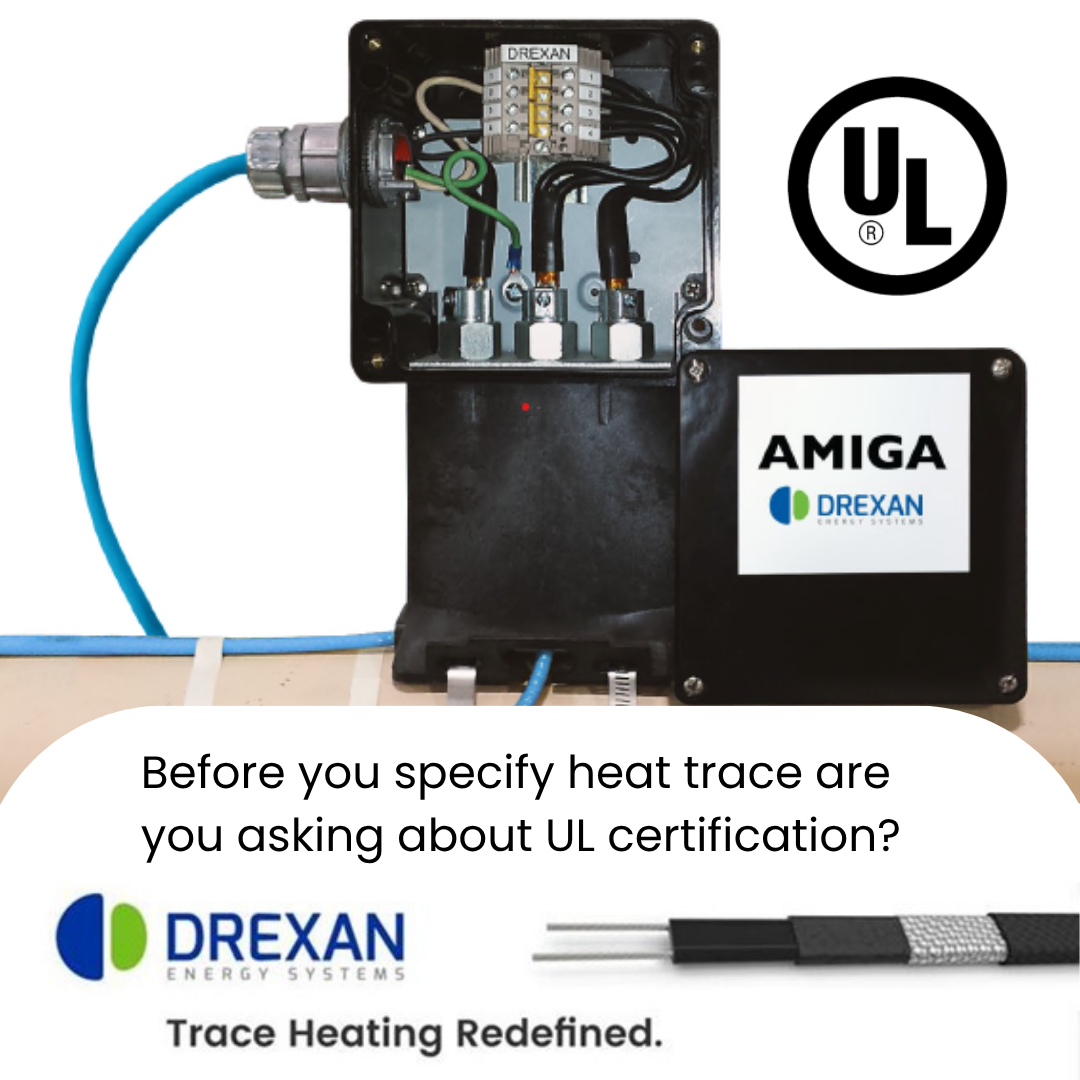
When engineers specify a heat trace system, there are many technical questions to consider, such as: How much heat is required? What are the minimum ambient and maximum exposure temperatures? What circuit lengths are needed? Is the application in a hazardous location? What controls and connection systems are appropriate?
Another important question that should be asked early in the specification process is if a heat trace system carries the appropriate UL certification for the application.
Not all heat trace products carry the same certifications. Selecting a product without verifying its certification and ratings can introduce unnecessary safety, compliance and project risk.
At Drexan Energy Systems, our HeatTracer cables and connection systems are certified to applicable CSA (cUS) and UL standards for use throughout North America.
Understanding what those certifications mean and verifying them before specifying or purchasing a heat trace system must be part of the design process.
What does UL certification actually tell you?
UL certification isn’t simply another logo on a product specification sheet. UL Solutions explains that products carrying its certification marks have been tested and evaluated against applicable standards. UL also conducts ongoing checks under its certification programs to confirm that manufactured products continue to comply with applicable requirements.
For engineers, contractors and facility managers, third-party certification provides an important level of confidence that a product has been evaluated against recognized requirements relevant to its intended application.
It is also important to understand exactly what has been certified. UL distinguishes between different certification designations and emphasizes that certification needs to be considered in relation to the applicable standard and conditions of use.
Have you verified the certification for the actual heat trace product and application you are specifying?
Why should engineers verify certification before specification?
A heat trace system becomes part of a facility’s electrical infrastructure. Depending on the application, it may be installed on critical water lines, process piping, tanks, fire protection systems, roofs and gutters, or equipment operating within hazardous environments.
The consequences of selecting the wrong product can extend well beyond the performance of the heating cable itself. Certification should be considered during design not after equipment has been purchased or installation has started.
Before specifying a heat trace system, engineers need to ask:
- What standards apply to this application?
- Is the heating cable certified for its intended use?
- Does the certification apply in both Canada and the United States where required?
- Is the product appropriately rated for the area’s environmental and hazardous-location classification?
- Are the connection, splice and termination components appropriately certified for their intended locations?
- Can the manufacturer provide documentation supporting those certifications?
These questions can help identify potential compliance issues before they become expensive field problems.
Are you looking at the cable or the complete system?
Certification becomes particularly important when designing trace heating for hazardous locations. It isn’t enough to look at the heating cable alone. Power connections, splices, tees, end terminations, junction boxes and cable entries all need to be evaluated for the environment in which they will be installed.
For example, Drexan’s PipeGuard self-regulating heat trace cables are rated for Class I, Division 1 applications. Drexan’s AMIGA connection system is CSA/UL (cUS) certified for hazardous locations up to Class I, Division 2. Drexan metallic connection components can also be used in Class I, Division 1 environments when installed with the appropriate DIV1-ADP (DREX0019) adapter at each cable entry.
This illustrates why heat trace certification needs to be considered as a system question, rather than simply a cable question. It’s critical that every component match the requirements of the location where it will actually be installed.
What can happen when certification isn’t verified?
The least expensive heat trace product on a quote isn’t necessarily the lowest-risk choice for the project.
If a product doesn’t carry the certification or rating required for its intended application, the implications can potentially include installation or inspection issues, redesign, replacement of equipment, project delays and additional labour and material costs. More importantly, using electrical equipment that has not been appropriately evaluated for its application can introduce safety concerns.
UL notes that codes and regulations commonly require electrical equipment to be certified to applicable safety standards, and that safety certification evaluates foreseeable hazards including fire and electrical shock.
In hazardous locations, the consequences of getting the specification wrong can be even more significant. Electrical components must be selected according to the area’s classification and installed in accordance with their certifications and applicable electrical-code requirements.
Certification is more than a procurement checkbox. It is part of managing project risk.
Does certification match the market where the system will be installed?
For companies operating on both sides of the Canada-U.S. border, another question becomes important: Is the heat trace system appropriately certified for use throughout North America?
Drexan HeatTracer products are designed with North American applications in mind. Drexan’s PipeGuard products, for example, are certified to applicable CSA/UL (cUS) standards for use throughout North America.
That provides engineers, contractors and facility teams with a consistent heat trace solution for projects operating across Canadian and U.S. markets, subject to the specific requirements and approvals of each application.
Ask Before You Specify
Heat trace design involves much more than calculating watts per foot. The performance, safety and reliability of the finished system depend on making the right decisions during design from cable selection and wattage tolerances to connection systems, controls, installation practices and certification.
Before approving the next heat trace specification, ensure that you’ve verified that the heat trace system is properly certified for where and how you intend to use it.
At Drexan Energy Systems, we believe engineers should have the information and technical support they need to make that decision with confidence. Our HeatTracer products are designed and certified for demanding industrial and commercial applications throughout North America, supported by a technical team that can help evaluate the complete heat trace system not simply the cable.
Do you have questions about certification requirements for your next heat trace project?
Talk to Drexan’s technical team before you specify. Call our North American TechLine at 1-800-663-6873.
Trace Heating Redefined.